
- Around 500 A.D., the Tongva people, original inhabitants of the Los Angeles Basin, settled the area. Their name translates to “People of the Earth.”
- By 1500, approximately 25 Tongva villages existed in what would become Los Angeles County.
- In 1769, Spanish settlers arrived, followed by the founding of Mission San Gabriel Arcángel in 1771, leading to the decline and assimilation of Tongva communities, later known as the Gabrielinos.
History and Museums
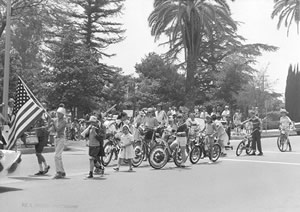
4th of July Parade at the intersection of Hermosa and Sierra Madre Blvd., circa 1970. Joe A. Hinojos Collection, Sierra Madre Historical Archives.
Local History Materials Now Available Free on California Revealed
In 2019, Sierra Madre Public Library (SMPL) was selected as a partner in the California Revealed project. California Revealed is a state funded initiative to help California’s public libraries, in partnership with other local heritage groups, to digitize, preserve, and serve online historically significant Californiana.
Four items from the Sierra Madre Historical Archives were digitized for the project: A Dictionary of Sierra Madre (1906), Bits from Wall’s Etched Books (1943), High Lights (1940-1948), and the Sierra Madre News (1906-1999).
These publications are now accessible and free to the public by clicking HERE
Explore our Local History collection
- Research the history of your home
- Find out about a local organization or business
- Select historical photographs for your project
- View early maps of your neighborhood
- Browse postcards of your community
Explore your own family history using Ancestry.com - The world’s largest online family history resource, with 7 billion genealogical records from across the globe and millions of family trees.
The Collection
Our local history collection consists of a variety of materials that tell the Sierra Madre story: photographs, slides, postcards, scrapbooks, city directories, maps, letters, periodicals, posters, works of art, sound recordings, moving images, and ephemera. Selected items are accessible via the Library's online catalog. The local history collection is built on a partnership. It is jointly owned and maintained by the Sierra Madre Historical Preservation Society and the Sierra Madre Public Library.
More to Explore
California Listens Project for Sierra Madre - NEW!
Timeline: Headline History of Sierra Madre features events of note by decade.
Map of Sierra Madre Landmarks Information about local historical landmarks.
Sierra Madre Historical Timeline
This timeline highlights key moments in the history of Sierra Madre, from its earliest Indigenous roots to the present day. Select a time period below to explore significant events, community milestones, and civic developments that have shaped the city over time.
Indigenous Roots and Early Settlement
Founding of Sierra Madre (1800s)
- In 1864, the Mount Wilson Trail was constructed, opening access to the San Gabriel Mountains.
- Nathaniel Carter purchased the land that became Sierra Madre in 1881, laying the groundwork for the town.
- The first schoolhouse was built in 1882, followed by the establishment of the Sierra Madre Water Company, library, cemetery, churches, and civic organizations.
- Rail access arrived in the late 1880s, supporting growth and connectivity.
Incorporation and Civic Growth (1900–1929)
- Sierra Madre officially incorporated as a California city in 1907.
- Early 20th century developments included electric service, telephones, paved streets, and expanded education.
- Cultural and community institutions flourished, including the Woman’s Club, public library, churches, and recreational facilities.
- The city gained regional recognition through events like the Mount Wilson Trail Race and Wistaria celebrations.
Community Resilience and Expansion (1930s–1950s)
- Despite major challenges—floods, fires, and wartime impacts—Sierra Madre continued to grow.
- The city acquired critical water rights, expanded public safety services, and developed schools, parks, and hospitals.
- Sierra Madre became a filming location for several major Hollywood productions.
- Civic organizations and cultural groups expanded during this period.
Preservation, Culture and Environmental Leadership (1960s–1980s)
- Sierra Madre emerged as a leader in historic preservation, arts, and environmental protection.
- The city became the first in Southern California to own a wilderness preserve.
- Restoration projects, cultural commissions, and community landmarks were established.
- Sierra Madre celebrated its centennial in 1981 with citywide events and recognition.
Modern Era and Community Investment (1990s–Present)
- The city has continued investing in parks, memorials, housing, transportation, and public safety.
- Major milestones include the opening of the Gold Line, new housing developments, expanded paramedic services, and disaster mitigation efforts.
- Sierra Madre has been recognized nationally, including receiving the All-America City Award.
- Ongoing preservation and community resilience remain central to the city’s identity.
This timeline highlights key moments in Sierra Madre’s history and is not intended to be a comprehensive record.
Contact Us
Sierra Madre Library
440 W. Sierra Madre Blvd.
Sierra Madre, CA 91024
(626) 355-7186
Sign up to our Newsletter
Stay up to date on the city's activities, events, programs and operations by subscribing to our eNewsletters.