
If you live in the State Responsibility Area (SRA) or the Very High Fire Hazard Severity Zone in the Local Responsibility Area (LRA), you are responsible for ensuring that your property complies with defensible space requirements that call for owners to take proactive steps to protect structures from wildfire.
Defensible space is an area where flammable material is removed or reduced to help protect people, homes, and communities from wildfire. Adequate defensible space aids in the safety of firefighters and helps to slow or halt the progress of fire that might otherwise overcome a structure.
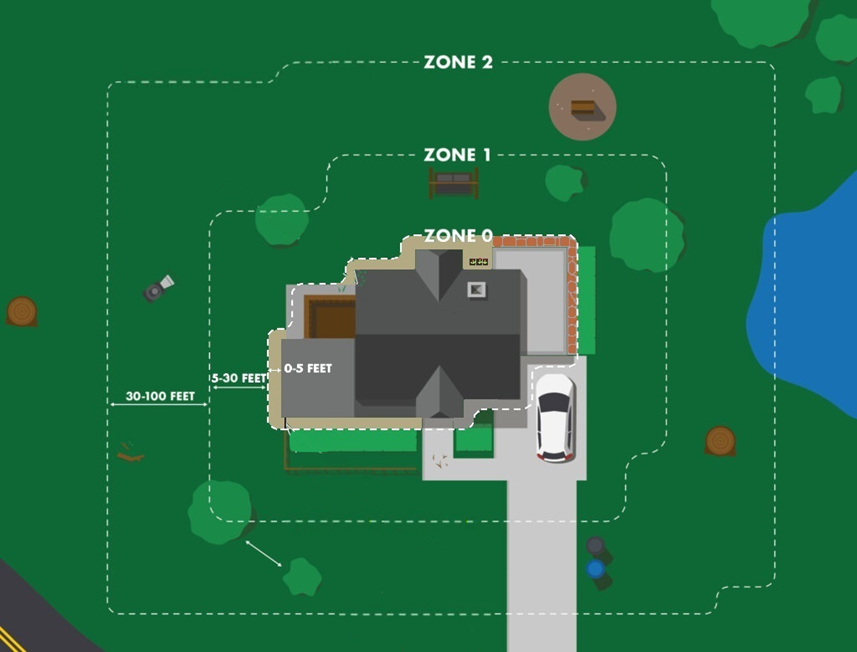
Zone 0 (0-5 feet from a structure)
In response to the increased frequency and intensity of wildfires in California over the last decade, the Legislature passed AB 3074 (2020) and SB 504 (2024), making changes to Public Resource Code 4291. These changes require the Board of Forestry and Fire Protection (Board) to establish an ember-resistant defensible zone the first 5 feet around a structure, referred to as Zone 0. Follow the Zone 0 rulemaking process on the Board of Forestry's website.
Zone 0 is the first five feet around a home or structure and is designed to reduce the risk of wildfire ignition from wind-blown embers and nearby combustible materials. The proposed regulations focus on keeping the area closest to the structure clear of combustible materials while allowing certain properly maintained vegetation and existing trees within portions of Zone 0.
Zone 1 (5-30 feet from a structure or to the property line if less than 30 feet) is designed to reduce wildfire risk by minimizing flammable materials and maintaining vegetation in a way that slows fire spread.
- Chimney- Remove any portion of a tree within 10 feet in all directions of a chimney. (Exempt- Oak Trees only require trimming when directly above chimney)
- Roof- Remove all vegetation living or dead on roof
- Overhang- Remove trees and vegetation within 5 feet above and below roofs, including climbing vegetation on a structure. (Exempt- Oak Trees)Recommendation- 3 feet horizontal clearance.
- Decks/Balconies/Stairs- Remove flammable vegetation and items below or adjacent to Decks, Balconies or Stairs
Zone 2 (30-100 feet from a structure or to the property line if less than 100 feet) is designed to slow the spread of wildfire by reducing the amount of vegetation that could fuel flames.
- Dead/dying- Remove dead or dying vegetation
- Grasses/Weeds- 3 inches max. 18 inches max on slopes greater than 20%
- Shrubs- Separate shrub fuels to a minimum of 4 feet or twice the shrub height, whichever is greater. When slope is greater than 20%, minimum of 8 feet or 4 times shrub height; whichever is greater
- Shrub Under Tree-Clearance above shrub must be at least 3 times height of shrub
- Trees- Prune branches from ground up to 6 vertical feet or 1/3 the height of the tree, whichever is greater
- Wood Storage- All wood piles should be at least 30 feet from any structure and have 10 feet of clearance in all directions down to bare soil. Unless, completed covered in a fire- resisted material
Requirements for property owners that have no distance threshold: Maintain roads to have all vegetation cut back horizontally to the curb, with 13 ½ feet of vertical clearance from the curb.
Residents can search by address and view the current designation of their property HERE. This online map also allows users to compare the newly updated zones with the 2011 adopted maps. Learn more about "Defensible Space" from CalFire.
Providing this defensible space is YOUR LEGAL responsibility and the key to defending your home during a wildfire. Working together we can battle the wildfire problem, but you must start around your own home. The Fire Departments Brush Abatement Program begins annually on June 1st. If you have any questions, or would like additional information, please contact contact Scott Rosevear, our Community Risk Specialist, at inspection@sierramadreca.gov or call 626-355-3611, extension 607, or visit the California Fire Alliance.